5 FREE top tips to keep your home warm this winter
Energy prices have been rising and now that we are officially into Winter, our Plumbing & Heating Division wanted to share some top tips to help keep your home warm this winter. And the best thing….none of these tips cost you a thing (well number 4 might depending on how far you go with it).
Tip 1 – Curtains
Get your curtains open in the morning to allow the suns heat to warm your home during the day. And as soon as the sun starts to go down in the evening, get them closed again. This helps to trap as much of the heat in your home as possible. And while it might seem obvious, don’t leave any gaps in the curtains. That will just let the warm air out. Winters are an easy spot for you to loose warm heat energy and curtains act as a great barrier against the cold glass.
Tip 2 – Move the sofa
So we say sofa, but really this could be any item of furniture in a room that is too close to the radiators. If your sofa is right next to the radiator (for example) then it is absorbing a lot of the heat being given out by the central heating system. By moving it away from the radiator, even a little bit, you are helping to pass more of the heat into the rest of the room.
Tip 3 – Turn down the heating a bit
It is advised that a room should be around 18°C yet for many homes in the UK, they are closer to 21°C. If you want to cut down on your heating bills then turn down the thermostat a degree or two.
Tip 4 – Stop the draughts
If your home has lots of draughts then you have lots or places for cold air to enter. Block them off. From draught proofing windows to draught excluders that sit by your door, you can even get little draught blockers for the front door key hole. And of course, if you have a fireplace that is not in use, you can plug the chimney to stop all that warm air escaping (though remember to remove it in the warmer months so that your home can breath).
Tip 5 – Bleed your radiators
An efficient radiator is a warm radiator. By making sure there is no air in the central heating system, a radiator can work more efficiently, hence cut down on your energy bills. Proper maintenance of your homes central heating system can ensure that you get the most ‘bang for your buck’ this winter.
Find out more
If you have tried all of these top tips and want to make even more savings on your central heating energy bills, then the next steps would be to upgrade your homes central heating system and boiler. Modern boilers are far more efficient than older models and while the cost savings vary depending on how inefficient your current boiler is and what type of new boiler you go for, the savings can be significant. This means that quite quickly, you can pay off the initial cost of a new boiler and start making some serious savings on your monthly and yearly energy bills.
Find out more about about domestic plumbing & heating with HF using the link below.
We are currently looking to recruit a Electrical Contracts Manager to be based in our Edinburgh Office
The ideal candidate should:
Have all relevant qualifications (18th Edition, cscs card)
Good organisational and time keeping skills
Ability to work to deadlines
Good interpersonal skills
Competitive salary and benefits package
As this position is of a permanent nature we are looking for individuals willing to commit and develop within our organisation to assist with our continued successful growth.
At the beginning of the week, we launched a poll on our Linkedin account to find out whether is should be called a lamp or a light bulb.
Why does it matter? Because when it comes to lighting terminology, a bulb is something you plant in the ground! Something that we always love to explain to our Apprentices when they first begin their journey with HF.
Well after a week of voting and many, many comments the results are in and the debate has been put to bed.
Hundreds of you voted and lamp won it with a dominant 74% of the votes.
Thank you to everyone who voted. Now, onto the next debate.
We recently published an information piece about whether you call a light source a lamp or a light bulb. In the eyes of our NIC EIC and Selected Accredited electricians, the fixture holds the lamp and the lamp is what provides the light.
Over the years, like with so many other aspects of life, terminology and how we refer to things has evolved; so while it should be referred to as a lamp, we know that the vast majority of the UK will refer to it as a light bulb.
But we decided to create a poll on our Linkedin page to find out what everyone else thought.
If you want to add your vote to the count then simply click the link below.
And if you want to know more about light bulbs vs lamps click the link below.
If you try and crack the joke ‘how many electricians does it take to change a lightbulb?’ you will instantly put our electrical division on edge.
Why? Because when it comes to lighting terminology, a bulb is something you plant in the ground! Something that we always love to explain to our Apprentices when they first begin their journey with HF.
What should you call a light bulb then?
You may call your vacuum cleaner a hoover and you may call that light source a light bulb. But ask any professional electrician and they will tell you that a light bulb is actually called a lamp and the thing you fit it into is called a fixture.
Fixtures (what most people would actually call a lamp) can be fixed or portable units. And in the eyes of our NIC EIC and Selected Accredited electricians, the fixture holds the lamp and the lamp is what provides the light.
So if that is what it is supposed to be called, then why do so many people call it a light bulb?
The history is a little bit sketchy but fundamentally, the reason that so many people call a lamp a light bulb comes from it’s shape. As the Dictionary states, a bulb is ‘Any solid object rounded at one end and tapering on the other, possibly attached to a larger object at the tapered end’. The dictionary also states that a lamp is ‘A device that generates heat, light or other radiation’.
Because of its shape, the common incandescent lamp (which is bulb shaped) became commonly referred to as a light bulb and for the vast majority of the UK population, that name (like the Hoover) stuck.
So…
The source of the light is called the lamp and the casing that houses the lamp is called the bulb. And this is then fitted into a fixture. Simple!
Over the years, like with so many other aspects of life, terminology and how we refer to things has evolved; so while it should be referred to as a lamp, we know that the vast majority of the UK will refer to it as a light bulb.
And now you know the answer to that question, let’s answer the joke…
‘How many electricians does it take to change a lightbulb?’
If you are happy to call a lamp a light bulb then it’s three – one to change the breaker, a second to rewire the circuit and a third to replace the fixture. (Note: the light bulb is not included.)
If you are not happy calling a lamp a light bulb then the answer is none. You plant a bulb in the ground.
Competitive salary and benefits package.
37.50 hours per week Mon-Friday + Overtime as and when required.
This position is of a permanent nature, we are looking for individuals willing to commit and develop within our organisation to assist with our continued successful growth.
Thermal imaging is a visual technology that allows us to see the heat radiated from an object.
A thermal camera assigns each temperature a shade of colour and converts the thermal radiation emitted from an object/objects that it sees into a visual picture.
Thermal cameras detect the difference in temperature by spotting and capturing the variations in infrared light being emitted. While this light is invisible to a humans naked eye, the thermal imaging camera technology can see it and converts it into visual data.
The captured footage from a thermal camera converts the infrared radiation using a measuring technique called microbolometers. Infrared radiation with wavelengths between 7.5–14 μm strikes the thermal camera detector material causing it to heat and therefore change its electrical resistance. This electrical resistance change is measured and processed into temperatures. Using the pixel ratio of the camera, each pixel is assigned a microbolometer. And all of these different coloured pixels helps to generate a visual representation of the ‘overall’ thermal image.
Thermal Cameras have come along way since they were first invented and while its inventor and origins are up for debate, the version of thermal imaging that we use today was originally developed in 1929. Its application for military use since then has helped to develop the technology and now we can use thermal imaging for all sorts of useful applications.
So what do we use thermal imaging for?
Fire & Security Systems
Security cameras equipped with thermal imaging technology are used to detect intruders. This technology is far more effective that traditional cameras operating at night because, while intruders may be able to use the cover of darkness to try and break into a location (around 80% or reported crime in the UK happens at night), thermal imaging CCTV cameras can spot them even in complete darkness; even when using various objects as cover such as shrubbery. Thermal CCTV cameras also have the advantage of not seeing the rain which can hinder traditional CCTV camera systems. This is ideal in the UK considering the almost constant rain that we experience.
Standard Thermal Imaging CCTV cameras can detect temperature ranges between -20oC and 150oC though more specialised variations can detect far higher temperature ranges.
Electrical Systems
Electrical equipment generates a lot of heat when in use. While there is generally a recommended operational range of heat build up that can be tolerated, thermal cameras can monitor electrical equipment temperature build up, ensuring that it is in a safe window. If an electrical power line (for example) begins to overheat beyond safety guidelines, the increased heat detected by the thermal imaging camera can be programmed to activate an alarm and report to a manned monitoring station; it can even be programmed to shut down electrical systems automatically. This fire warning system can provide a vital fire deterrent in many manufacturing businesses as well as IT and Technology facilities and can save vital operational assets and electrical equipment from significant fire damage.
Our Electrical Contractors can also use thermal imaging cameras as part of Periodic Inspection & Testing for clients where requested to spot stress points in electrical wiring and control boards.
Infection Control Systems
The global coronavirus pandemic has seen an increased use of thermal imaging in a new role. One of the early signs of possible covid-19 infection is a rise in temperature. Thermal imaging can detect elevated body temperature and, integrated with access control systems, prevent infected individuals from entering a premises. This can provide a vital solution in reducing the potential spread of infection and disease in a workplace or high foot traffic event.
Plumbing & Heating Systems
Thermal cameras can be used to identify leaks in plumbing systems, check for heat loss in HVAC equipment and inspect heating systems to ensure an even spread of heat on the likes of a radiator. Thermal cameras can also be used for heating, ventilation and air conditioning systems.
About Us
With senior-level hands-on management from initial planning to final handover, and with the opportunity to tap into a wide range of varied services and associated consultants with a skills base and command of technologies which are second to none. Working with HF Group is more than just another service contractor.
HF’s family culture means much more than dates and numbers. It’s quite literally, the core of the business. We consider all of our employees as part of the family and invaluable assets to our ongoing success. So we continually invest in training and development, allowing the entire team to share in a thriving and mutually supportive working environment.
From Fire & Security Services to monitoring key electrical equipment, thermal imaging offers huge safety and security advantages for businesses in multiple sectors. To find out more about thermal imaging and how it could benefit your business, contact us today.
The 21st of December is when Winter officially begins it feels like it has come a lot earlier than that.
Are your radiators ready for the cold months?
During the summer, domestic and commercial properties heating system commonly sit idle with little thought being given to them. Which most likely means that it has been a long long time since the radiators in the building have been bled.
To help you get back into the practice of bleeding a radiator, here are our step by step guide to bleeding a radiator. Bleeding a radiator is important to ensure that there is no air in the system for greater energy efficiency of the properties radiators.
Warning: The water inside of a radiator can be very hot. Please take care when bleeding a radiator so that you do not scold yourself.
How to bleed your radiator
1. Ensure that the radiators in the property are evenly warmed up. Depending on the size of the property and how many radiators are fitted, this may take a while.
2. Going from radiator to radiator, check each one to ensure that there is an even temperature spread across the whole area of the radiator. If there is not an even heat spread (ie. the top of the radiator is cold and the bottom is hot) then that radiator has air in it and needs to be bled.
3. Turn off the boiler system and wait for the radiators to cool.
4. On the first radiator, using what is called a radiator bleed valve key, open up the bleed valve that is generally located in the top corner of the radiator. Turn the bleed valve anti clockwise slowly. Have a cloth or rag to hand and position underneath ready to catch any excess liquid from the radiator. As the valve opens, it should emit a hissing sound as air escapes from the radiator.
5. Once the hissing sound stops, water inside of the radiator will begin to leak out. At this point, close the bleed valve by turning the radiator key clockwise.
Repeat steps 4 and 5 for all of the other radiators in the property.
6. When you bleed radiators, it can lower the boiler pressure. If the boiler pressure has dropped below 1 bar of pressure then you will need to re-pressurise the system (It should be between 1 and 2 bars of pressure).
Don’t let the title fool you. We are not talking about making it easier for just anyone to enter a premises. What we are talking about is easy controlled access for those who need it.
Picture the scene. A frequently used auto locking door that requires a key. Every time that a member of staff needs access, they need to have the key on them. In a business with multiple staff, do they all have a key? Do they need to sign in to get access to the key? For what seems like a simple access issue, it can easily spiral into a complicated security issue.
So what are the options? Controlled access security systems using code locks.
Whether controlling access to certain areas of a commercial premises or working in tandem with other security and fire systems, code lock security systems offer users a convenient standalone solution that provides easy access to low, medium or high security risk entry points whilst doing away with keys which can be cumbersome and easy to loose.
There is a huge range of code lock entry systems available to suit almost any security need. From heavy duty mechanical push button lock systems for minimal security access to sophisticated digital systems that are compatible with NFC and MIFARE systems as well as intruder alarm systems.
The sky is the limit when it comes to access control systems. If you are simply looking for a security system for low risk door access (such as the back door of a restaurant) then mechanical systems are an ideal and cost effective solution. But when you enter the digital world of code lock systems, you can begin to tap into additional benefits like integrated clock in/clock out systems, restricted access controls and time sensitive access. This makes them ideal for larger businesses that want to monitor and control staff presence for fire, security and workplace punctuality.
Access control systems can be synced with businesses heating systems and office lighting in order to increase energy efficiency in a workplace and cut down on wasted heat energy in areas of a building with nobody in them. Access control systems can ensure that lights are turned off and the heating is turned down in office spaces that are empty. These small energy savings on a day to day basis can add up to very big energy cost savings through the year.
The flexibility of code lock security systems can offer businesses enhanced security systems that are a far more appropriate solution to security entry than traditional lock and key security systems and as businesses move to a hybrid business model, Access Control Systems can offer safety, security and staff attendance tracking that can be completely customised for your business needs.
Our Fire and Security Services are NSI Gold and NSI Fire Gold accredited and we can design, install and offer maintenance contracts for Fire Systems, Access Control Systems, CCTV and Intruder Alarms nationwide. If you would like to know more about our Fire & Security Services, examples of the work we have done in this sector or if you have any questions about bespoke services for your individual needs, please call us today on 0800 783 9480 or email info@hf-group.co.uk. We look forward to hearing from you soon.
In fact, with so many security and detection features available in modern intruder alarms, there are actually 4 different grades of alarm system in the UK. This is based on the level of performance (Reliability, Durability and Features) that the intruder alarm offers.
Why it is important to understand the different security alarm grades.
If you are considering installing a new alarm system for your home or business (are are needing to upgrade your system) then understanding the differences in the grading system is paramount both for your building security and the requirements of insurance providers.
How does the Intruder Alarm Grades work?
Intruder alarm systems available in the UK and Europe all share a categorised grading system between 1 and 4. The grades are based on the level of sophistication in the security system and it’s resilience against intruders who are trying to break into a premises. Grade 1 represents the lowest level of security grade and Grade 4 represents the highest.
The difference between Intruder Alarms for Homes and Businesses
Residential homes and Business Premises all share the same Intruder Alarms grading system. Most intruder alarms installed for domestic homes are either a Grade 1 or a Grade 2 alarm system. Larger homes and homes that are deemed high risk often have Grade 3 intruder alarm systems fitted.
Commercial premises, retail stores and other manufacturing facilities will have a Grade 2 or Grade 3 Intruder Alarm system (though many Insurance providers are now requiring Businesses to upgrade to a full Grade 3 system). While Grade 4 is the highest level of Intruder Alarm, they are generally only used by High Risk Facilities that have higher valued on site assets that need protecting.
What if a property has a combination of graded alarm systems?
An Intruder Alarm System is only graded as high as the lowest grade components fitted in the system. This means that if you have mostly Grade 3 components installed as part of your security system but just one Grade 2 component, the entire system would be graded as a Grade 2 Intruder Alarm System. This is because even with that one device, it create a vulnerable point in the security system that can be better exploited by intruders and as such, brings the entire security level down.
What does each Grade offer?
Grade 1
This is the lowest grade level of security and is designed to protect against the most basic of theft and intrusion acts. Grade 1 systems work well as a visual deterrent and provide adequate security against less experienced intruders and thieves who are trying to access a property.
Grade 1 systems are generally found on access doors but may not offer protection for windows (for example) and are mostly used for low risk buildings that do not contain valuable assets.
Grade 2
The next step up in Intruder Alarm Security, Grade 2 alarm systems offer an additional level of security thanks to more sophisticated technology and are seen as a more reliable solution. Grade 2 alarms offer more of a challenge for burglars who posses some level of experience and knowledge in what they are doing. Grade 2 alarm systems protect against multiple entry points in a building and are far more suitable for higher risk homes and low risk commercial properties. Businesses are however now being encouraged by their Insurance providers to upgrade to Grade 3 Intruder Alarms across the UK.
Grade 3
A far more sophisticated and robust system that is designed to protect properties from intruders who posses advanced knowledge and equipment for breaking and entering. Grade 3 systems MUST be comprised entirely of wired components and protect all potential access points of a building. Grade 3 Intruder Alarms are now a standard requirement for businesses, commercial properties and high risk homes across the UK based on recommendations from the leading insurance providers in the country.
Grade 4
The highest level of Intruder Alarm Security System currently available. Designed to protect properties against the highest level of professional, targeted attack. Due to the sophisticated nature and higher standards to achieve the grade, Grade 4 Security Systems are only found in high risk properties that contain valuable and/or dangerous contents.
How do I know what Grade level I need
At HF Fire & Security, our Intruder Alarm Services are backed up with NSI Gold and NSI Fire Gold accreditation so that we can operate to the highest possible industry standard and guidelines across the UK. Our team can advise you on all types of security system that you should have, giving you the very best in security to suit your needs. We can review your domestic or commercial property and provide recommendations on what products, system design and installation requirements you should have.
What Security Systems can we fit?
The security systems that we can fit are dependant on your unique property needs but we can offer:
From fire detection systems to control measures such as sprinkler systems that help to minimise the risk of fire damage to importance assets and to human life.
One of the most effective security monitoring systems available. The latest CCTV systems are fitted with night vision, comms systems and lighting systems that can work alongside intruder alarms.
Door entry systems that can use thermal control to limit access while biometric facial recognition can offer contactless ‘clock in/clock out’ functionality.
With a maximum 4 hour Security Services Response time and 8 hour maximum Fire Services Response Time, our Security Engineers are available with fast acting telephone support to provide instant solutions to many of the most common fire and security issues that your business may encounter.
Year round maintenance and servicing
With branches across the UK, we can provide year round call out cover for intruder alarm maintenance, servicing and repairs.
Safety and security are, as with everything we do at HF, paramount. And with security and fire safety services tailored to your businesses size, complexity and bespoke requirements; we are proud to offer a 24/7 call out service as part of an extensive aftercare package that ensures your business stays secure all day, every day.
Find out more
With senior-level hands-on management from initial planning to final handover in everything from facilities management services to advanced communication systems; we our incredibly proud of the services that we can offer our customers. It all adds up to a service fully focused on protection and delivering your requirements on time and on budget – because anything else, quite simply, won’t do.
If you would like to know more about our Intruder Alarms, examples of the work we have done in this sector or if you have any questions about bespoke security services that you are looking for, please call us today on 0800 783 9480 or email info@hf-group.co.uk. We look forward to hearing from you soon.
Plan engineers working diaries and schedule jobs with clients
Update Client portals
Provide holiday cover for the main Mechanical service coordinator
Answer Calls and queries from clients and engineers
Follow in house call monitors to ensure clients are kept up to date
Hours:
Mon – Thurs – 8am to 4:45pm (4pm on Fri)
Salary negotiable upon experience.
As this is a long term position, we are looking for individuals willing to commit and develop within our organisation to assist with our continued successful growth.
No Agencies please
Please apply to:
HF Mechanical Services
8 Harrison Lane
Edinburgh
EH11 1HG
enclosing your CV and current salary
or e-mail: hfpersonnel5575@gmail.com
(Online application forms available upon request)
Due to volume only successful candidates will be contacted. HF is an equal opportunities employer.
Plan engineers working diaries and schedule jobs with clients
Update Client portals
Provide holiday cover for the main F&S service coordinator
Answer Calls and queries from clients and engineers.
Follow in house call monitors to ensure clients are kept up to date.
Hours:
Mon – Thurs – 8am to 4:45pm (4pm on Fri)
Salary negotiable upon experience.
As this is a long term position, we are looking for individuals willing to commit and develop within our organisation to assist with our continued successful growth.
No Agencies please
Please apply to:
HF Fire & Security
8 Harrison Lane
Edinburgh
EH11 1HG
Fire prevention and detection is a constantly developing industry where every second counts.
The quicker a fire can be detected, the quicker (and more likely) it can be controlled. In domestic properties, the standard smoke alarm is king. However in industrial complexes, large indoor retail stores and even airports, standard smoke detectors are uneconomical and have too many restrictions to make them a viable fire detection system.
Step forward optical beam smoke detectors.
An optical beam smoke detector is a simple solution works on the principle of light obstruction and uses a projected beam of light to detect smoke. This detection system can be used in large indoor areas where other forms of smoke alarm are simply not effective enough. The system has many advantages over other smoke detection systems including large area coverage, reliability, and even quick installation times. Depending on the size and space of the location that needs an optical beam smoke detector system installed, a single system can comfortably be used for spaces between 50 & 100 metres. Multiple units can be used to cover larger spaces and be interconnected to the buildings fire alarm and sprinkler system.
How does it work?
There are two types of optical beam smoke detector. End-to-End and Reflective.
End-to-End Smoke Detectors (also known as projected smoke detectors)
An end-to-end smoke detector uses a separate light transmitter and receiver. They use open-area smoke imaging detection in two wavelengths of light which are configured to detect smoke. These are UV and IR wavelengths. The UV and IR wavelengths of light react to fire smoke differently and this difference creates reflection variations resulting in different profiles of light. The detection system can then identify these variations as fire smoke and activate the fire alarm system. If the UV and IR light reacts identically to obstacles in the light beam (such as bugs, steam, dust etc) then it will class these as false alarms. By using UV and IR lights, the optical beam smoke alarm can detect smoke more accurately.
Reflective Smoke Detectors
Reflective Optical beam smoke detectors work by utilising reflective detection technology. An optical beam smoke detector is formed of two core units. The transmitter-receiver and a reflector. The transmitter-receiver emits a constant beam of infra-red light at the reflector which has a prism that angles the infra-red light back at the transmitter-receiver. If the light beam is distorted (because of fire smoke) then it activates the fire alarm systems.
The smoke will reduce the strength of the infra-red light beam and the transmitter-receiver is configured to detect these variations.
Because both of these two optical beam detection systems operate with only two components, it means the size of the detector system is very small. This has its advantages in installation requirements, especially if the smoke alarm system is being installed in heritage locations such as a church or retail locations such as a shopping centre.
Where can optical beam smoke alarms be used?
Airports
Historic Buildings (Churches & Mosques)
Conference Centres
Exhibition Centres
Distilleries/Breweries
Hospitals
Hotels
Manufacturing Facilities
Schools
Shopping Centres
Sports & Leisure Centres
Storage Parks
IT Data Centres
Warehouses
Find out more
Our Fire & Security division of HF Group offers complete business and personal fire and security solutions nationwide. Our Fire and Security Services are NSI Gold and NSI Fire Gold accredited and we can design, install and offer maintenance contracts for Fire Systems, Access Control Systems, CCTV and Intruder Alarms nationwide.
No delays, no excuses, no time-wasting.
Our clients range from one off domestic properties or single unit business all the way to large high st names. At Scotland’s flagship Murrayfield Stadium (for example),we provide a range of alarm maintenance, CCTV and security monitoring, including crucial Fire Alarm Engineer cover on match-days.
If you would like to know more about our Fire & Security Services, examples of the work we have done in this sector or if you have any questions about bespoke services that you are looking for, call us today on 0800 783 9480 or email info@hf-group.co.uk. We look forward to hearing from you soon.
We have an exciting new opportunity for an enthusiastic candidate to join the HF Group in a permanent role that promises unique challenges, a varied workload and great career progression opportunities within the company.
We are currently looking to recruit a Project Coordinator to join HF Comms Ltd
Daily Tasks:
Arranging RAMS, Access Permits and RF outages
Organising vehicles, travel, keys, cranes, mewps, job packs, site clearances and anything specific to individual site requirements.
Liaise with engineers and PMs and assist with any issues that may arise on site.
Furnish Project Managers with twice daily updates of works.
Report details of near misses to SHE.
Arrange POs and action Reports relating to finance.
Maintain spreadsheets.
Arrange courier deliveries.
Allocate labour to jobs and arrange payments of wages via in house system and POs.
General Admin duties *list not exhaustive.
Salary negotiable upon experience.
As this is a long term position, we are looking for individuals willing to commit and develop within our organisation to assist with our continued successful growth.
Benefits/Additional Perks
Private Medical Cover
Critical Illness Cover
Auto Enrolment Pension
Death in Service Insurance
Perkbox Subscriptions
No Agencies please
To apply for this role or for to be considered for further roles at HF Group, please contact:
HR Manager
HF Group
100 Albert Drive
Glasgow
G41 2SJ
enclosing your CV and current salary or e-mail: personnel@hf-group.co.uk (Online application forms available upon request)
HF is an equal opportunities employer.
Please note your employment is conditional upon the Company’s receipt of satisfactory references and if requested by the Company, a satisfactory Disclosure and Barring Service check.
Disclaimer: due to the high volume of applications that we receive, we reserve the right to close a vacancy earlier than the advertised date. This is to ensure that we can manage application levels while maintaining a positive candidate experience. Once a job vacancy has closed, we are unable to consider further applications, so please submit your application as soon as possible to avoid disappointment.
Due to volume only successful candidates will be contacted.
The sites and sounds of fireworks are a popular choice for many on Guy Fawkes Night (aka Fireworks Night), New Year or one of the many sporting events held throughout the year.
But while they may light up the sky in beautiful patterns, there are a lot of cons to fireworks including:
Damage to private property
They create litter
They can scare domestic pets
They are dangerous
For some they are too noisy
They are bad for the environment
They are a fire risk
But what are the alternatives?
Drone technology has been developing leaps and bounds in recent years and equipped with LED lighting, they are now offering a true alternative to fireworks.
The software developed for drones creates pre programmed flight patterns that allow the LED lighting fitted to the drone to create digitised firework displays that can do so much more than just go boom. They can animate the sky in very interesting ways and have the advantage that they are reusable, green and non-polluting.
So how does a drone firework display work?
Software is the driving force behind it. The drones are flown and controlled by pre-programmed software. This means they can be timed to react to music that plays during the event and because the drones can hold station in a set position in the sky for long periods of time, the displays can create three dimensional visuals. And all of this can be done with a near infinite amount of colour and brightness controlled by LED lighting.
So can the drone fireworks do more than just replicate fireworks?
They can indeed. They can create words, logos and even characters in the dark night sky. In fact, such is the detail that a drone firework display can create that in April of this year, a Chinese display using drones created a scannable QR code in the sky!
How many drones are needed?
It really depends on what scale you want your display. The Guiness World Record for the largest number of drones flying in the night sky is currently 3,281 which were used to create a car company logo.
Promoting LED Lighting and Green Solutions
What we most like about the promotion of drone firework displays is that it is helping to push and demonstrate the advances in LED lighting technology and green solutions. And while LED lights on a drone can create amazing displays, they can also be used to great effect as a way of lowering a businesses energy consumption in a month. With the ban on sales of Halogen light bulbs in the UK now in effect and Fluorescent lighting soon to follow the same path, upgrading your lighting to LED is a positive green energy solution that has real environmental benefits.
Find out more about switching to LED lighting and the benefits of LED lighting using the links below.
And we thought we would share a few jokes that tie in quite nicely with our services which could act as inspiration for those yet to decide on what their Trick or Treat act will be.
So…
Do you know what electricians talk about? Current Events.
What kind of car does an electrician drive? A Volts-wagon.
What’s the one thing professional poker players and plumbers can agree on? A royal flush is better than a full house.
My combi boiler might be sick. I think it’s the flue!
Why did the bakery install a security system? To protect the dough!
We hope you have a fun time on Sunday for Halloween but equally important is the fact that also on the 31st is Day Light Savings.
The clocks go back 1 hour at 2am on Sunday. This will take us out of British Summer Time (BST) and into Greenwich Mean Time (GMT).
We are currently looking to recruit experienced 18th Edition Electricians & Approved Electricians based from our Glasgow, Edinburgh & Aberdeen branches. Desired qualifications but not essential; Testing 2391 Course. IPAF 3a & 3b, PASMA, Compex 01-04 & SSSTS qualified.
Applicants must have experience in managing mobile operator network upgrade projects.
Desired qualifications but not essential:
Testing 2391 Course
IPAF 3a & 3b, PASMA
Compex 01-04
SSSTS qualified.
The ideal candidate should possess:
All Relevant qualifications are essential
Good organisational and time management skills
Ability to work to deadlines
Good interpersonal skills
Competitive salary and benefits package.
37.50 hours per week Mon-Friday + Overtime as and when required – On Call Rota System in place.
This position is of a permanent nature, we are looking for individuals willing to commit and develop within our organisation to assist with our continued successful growth.
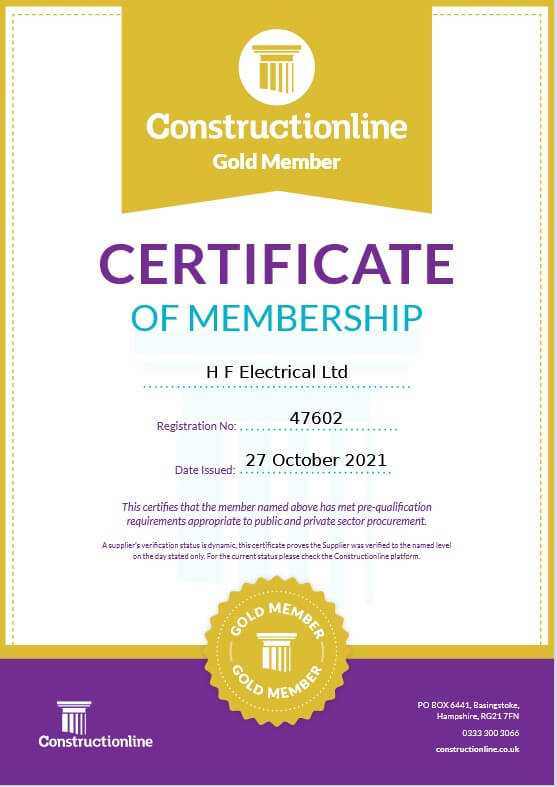
We are delighted to announce that we are now Gold Membership Accredited with Constructionline.
Constructionline have been supporting construction and facility management businesses in the public and private sector for well over 20 years! Originally established by the UK Government in 1998, their mission is to help members simplify procurement risks and keep pace with legislation.
What is Gold membership
Gold Memberships Accreditation demonstrates that we have met the PAS 91 and Common Assessment Standard and pre-qualification across core modules required by the Public and Private sector.
Being Gold Accredited verifies that we have been assessed by Constructionline for our credentials in environmental management, quality management, equal opportunities, modern slavery act adherence and anti-bribery and corruption policies.
A selection of these policies form part of the Cabinet Office Selection Questionnaire (SQ), which the public sector is expected to comply with.
What does this mean?
By receiving Gold Membership Accreditation with Constructionline, we can guarantee:
Secure Data Storage
Verified Membership
SSIP Included
We meet PAS 91 Requirements
Common Assessment Standards
What is PAS 91 Standardisation?
PAS 91 is a standardised pre-qualification questionnaire. It has been created to reduce the need for suppliers to complete a variety of different pre-qualification questionnaires. It has been developed directly by the British Standards Institute (BSI) and is a recommended common minimum standard for construction procurement in the UK.
PAS 91 is intended to:
Help suppliers understand what information is needed at pre-qualification stage.
Increase consistency between pre-qualification questionnaires and databases.
Help buyers identify suitably qualified contractors.
What is the Common Assessment Standard?
The Common Assessment Standard is a standardised set of questions that have been put together from existing systems with input from clients, suppliers and trade organisations across the UK.
Did you know that the cables and electrical installations that electrical current flows through will age.
It isn’t planned obsolescence, it is simply a fact that electrical wiring, equipment and control gear deteriorate over time.
This means that you should have any electrical installations in a building inspected and tested periodically to make sure that they are in good condition and safe to be used.
It may seem obvious but electricity is dangerous. Periodic Inspection and Testing helps to ensure that the electrical equipment and wiring in a building is safe to use. There are around 35 deaths per year and over 4,000 injuries per year in the UK because of electrical issues. In industrial complexes and factories, the electrical demands of manufacturing machinery generates a lot of heat which can cause overheating issues and electrical fires. Having Periodic Inspection & Testing can help reduce electrical shock injuries and cut down on the risk of electrical fires.
Find out more
From Electrical Installations to Planned Maintenance Contracts, quality service and peace of mind are the principles on which the Fulton family founded the company and its electrical services all those years ago, and it’s just as important today.
Our unique combination of family continuity, in-depth business and technical knowledge and an investment in recruiting and developing the very best skillsets, means that our customers still benefit from the highest possible standards of electrical service and delivery – the hallmark of HF since its inception.
How loud is a smoke alarm may not warrant the ‘how long is a piece of string’ response, but there is no simple answer to how loud an alarm is beyond the obvious – very!
The reason that it is not a simple question to answer is that there are different types of smoke alarm that get used in different types of situation.
The average smoke alarm sold in the UK is required to produce a sound of 85 decibels from a distance of 3 metres. Everyone’s hearing ability is different and in different scenarios, you may be experiencing background noise that far exceeds 85 decibels. In an industrial working environment for example, anything beyond 85 decibels requires hearing protection.
The loudest football stadium in the UK has been measured as Anfield in Liverpool (2011) which recorded decibels levels of 97 with fans singing and chanting.
On the other end of the noise spectrum, a library is an average of just 30 decibels while an office environment, which is also quite quiet is around 60dB. In commercial setting such as an Office or Restaurant, Fire Alarm Systems that are fitted with smoke detectors/sounders are set at 15 decibels above the average sound level in the room.
Can a smoke alarm damage your hearing
The sheer volume of noise isn’t everything and the distance you are from the source of the sound and how long you are exposed to it is just as important as the noise. Sound intensity doubles with every increase of 3 decibels so even though the sound of a car horn may not sound twice as loud as a vacuum cleaner, the intensity levels make it seem so. That is why, if you are working in a noisy environment with sound levels in the region of 80-85dB, you should be wearing protective hearing headsets. For sounds in the region of 110 – 120dB, short exposure is enough to cause lasting hearing damage.
Prolonged and repeated exposure to loud noises can damage your hearing and if you stand next to a smoke alarm for a long period of time, it can damage your hearing – though the point of a smoke alarm is to get you out of the vicinity of a fire so this is rarely an issue. The louder the noise is and the longer you are exposed to it, the higher the risk to your hearing.
How loud is a smoke alarm on the other end of a house with closed doors?
Tests conducted using an 85 decibel smoke alarm show that from the other end of a standard UK built 3 bedroom home with doors closed, the sound drops to just 45dB which is around the same noise level as a loud cat meow.
Is that loud enough?
The Scottish Government are introducing interlinked smoke alarms for all homes to try and keep this sound level at a high value throughout the home. Is that enough is the subject of debate for many in the industry however. If you have ever slept through an alarm clock then you will know that loud noises are not always the be all end all.
What about those with hearing disabilities?
Fire can occur to anyone at anytime. Those who are deaf or hard of hearing cannot rely on audible smoke alarms in the same way that those who good hearing can which means that there is a wide range of other smoke alarms available for hearing impaired individuals.
Find out more
Smoke alarms have, time and time again saved lives. whether it is in office space, an industrial facility, restaurant or your home, smoke alarms save lives yet too many people do not have adequate smoke alarm protection in their homes. It is the law that commercial premises have them fitted and it will be part of the Governments legislation from February 2022.
To find out more about Smoke Alarms and the options for your home or business please contact us today.
We are currently looking to recruit a Mobile Telecoms Build Project Manager. This is a long term position with flexible working arrangements.
Applicants must have experience in managing mobile operator network upgrade projects.
Daily Tasks:
Management of the project, on a day-to-day basis
First point of contact for customer Project Manager(s)
Programming/Scheduling of jobs in line with customer’s requirements (including defect clearance)
Management of jobs
Equipment call off
Management of outages for your projects
Management of access permits for your projects
Management of project finances for your projects
Analysis of site survey reports
Analysis of site drawings
Analysis of tenders
Creation of Addition to Orders (ATO’s), where necessary
Creation and tracking of monthly estimates (including providing detailed explanation behind the figures)
Production of Interim and Final Accounts
Validation and approval of field team’s timesheets and expenses
First POC with field teams regarding technical advice and escalations
Technical expert on all scopes of work particular to the project you are working on
Salary negotiable upon experience.
As this is a long term position, we are looking for individuals willing to commit and develop within our organisation to assist with our continued successful growth.
Congratulations to our own Kevin Bryce, the Apprentice Plumber of the Year
We are delighted to announce that our Mechanical Apprentice Kevin Bryce has been awarded the Apprentice Plumber of the Year.
In only his second year in the apprentice programme, Kevin was nominated by Forth Valley as their selected SNIPEF registered apprentice and we are delighted that he has become this year’s winner of The Best Apprentice Plumber Award after all the hard work he has put in while learning from our existing Mechanical Division team.
“Kevin is always first to ask a question, get on with his work or complete a practical exercise. He is an asset to his employer and the college and a pleasure to teach”
“Kevin always takes on any task with 100% commitment and is neat, tidy and very conscientious. His ability to learn new skills and put them into practice has been great and he has become a real asset to the company. I am delighted his dedication and hard work are being recognised”
Apprenticeships provide new opportunities for those working towards a specific and relevant qualification. As an apprentice, you are employed in a real job whilst studying a relevant educational course. The core goal of an apprenticeship is for those that take part to have gained the skills and knowledge needed for success in their chosen sector.
Apprenticeships and HF Group
As a group of world-class companies leading the way in next-generation technologies; and all with a family continuity at management level which is rarely seen; we are always looking for quality, talented and enthusiastic new members to our team. Apprenticeship Programmes are incredibly important to us as we are always looking to grow and strengthen our team in Electrical, Mechanical and Fire & Security Sectors.
We offer apprentice opportunities in our Glasgow, Edinburgh, Aberdeen, Manchester and Belfast sites and are very proud of the apprentice programmes we work with as they really do help to give apprentices the opportunities to learn from our existing team.
Find out more
We are always looking for quality, talented and enthusiastic new members to our team and therefore have apprentice opportunities across the country. To find out more, visit our Apprentice page using the link below.
We are delighted to announce that we have just hit 1,500 followers on our HF Group Linkedin account.
While we have had a Linkedin account for a number of years, we have only recently decided to put more effort into updating our customers and followers on the interesting projects we get to work on, relevant new legislation in the industry and other fun facts.
And so far, it seems as if people approve as we have seen a lot more growth in followers since we started.
If you would like to keep up to date with the latest news on HF Group and our range of services, all you need to do is connect with our Linkedin profile by clicking the button below.
There is just 11 days until COP26 begins in Glasgow. COP26 is of course the annual UN climate change conference which this year will be held in Glasgow where our head office is located.
COP stands for ‘Conference of the Parties’ and is attended by the countries who are members of the United Nations Framework Convention on Climate Change (UNFCC).
COP26 will be held between the 31st October and the 12th of November in Glasgow and is running a year later than originally planned due to the Covid-19 pandemic.
With an estimated 30,000 people attending, and with the ongoing environmental issues, it expected to be the biggest climate event since the Paris Agreement in 2015.
There is going to be a lot of disruption for residents in Glasgow and because our head office is in the South Side, we will not be immune from it all.
There is a handy website we thought we would share a link to in case you didn’t already know about it.
Because we need to move to more environmentally friendly and sustainable solutions in our day to day lives, COP26 gives the countries attending a chance to meet, discuss and announce far more ambitious goals and targets to reducing climate change as we move to become net zero. Climate change is the single biggest threat facing our generation which is why moving to clean energy is so critical.
How does this relate to HF Group?
From energy surveys and design all the way to full installation and year round maintenance contracts., we offer a bright way forward for energy solutions in your business. Leading the charge towards a more sustainable and efficient future, HF Green Energy Services is a bold new direction from one of the oldest and most highly regarded services contractors in the UK. Moving to green energy is a must for everyone. At home and at work. And as companies need to move from fossil fuels for transportation and power generation, we are here to help with EV Charging Systems, Solar Panels, Thermal Heating Systems and Battery Storage Solutions that can allow business in the UK to move towards a greener future.
We are currently looking to recruit a Mechanical Contracts Manager to look after Mechanical Projects ranging for 30k to 500k
The ideal candidate should:
Have all relevant qualifications (gas certification, cscs card)
Be based in either East or West Coast
Minimum 5 years’ experience
Good organisational and time keeping skills
Ability to work to deadlines
Good interpersonal skills
Competitive salary and benefits package
As this position is of a permanent nature we are looking for individuals willing to commit and develop within our organisation to assist with our continued successful growth.
No Agencies please
Please apply to:
HF Mechanical Services
8 Harrison Lane
Edinburgh
EH11 1HG
We are currently looking to recruit experienced Plumbers & Commercial Gas Engineers
The ideal candidate should possess :
All relevant qualifications are essential
Knowledgeable of fault finding on all aspects of Plumbing and domestic boilers etc.
Good organisational and time keeping skills
Ability to work to deadlines
Good interpersonal skills
Competitive salary and benefits package
37.5 hours per week Monday to Friday plus overtime as and when required
On call Rota system in place
Company uniform & van will be provided
As this position is of a permanent nature we are looking for individuals willing to commit and develop within our organisation to assist with our continued successful growth.
Commercial Gas Engineer
The ideal candidate should possess :
All relevant qualifications are essential (Gas Certification, CSCS Card)
Completed a recognised Apprenticeship
Minimum 5 years experience
Fault finding and service experience
Good organisational and time keeping skills
Ability to work to deadlines
Good interpersonal skills
Competitive salary and benefits package
37.5 hours per week Monday to Friday plus overtime as and when required
On call Rota system in place
Company uniform & van will be provided
As this position is of a permanent nature we are looking for individuals willing to commit and develop within our organisation to assist with our continued successful growth.
You will have heard a lot in the news about the UK Government’s new grant scheme that is being introduced to encourage customers to switch from gas boilers to heat pump systems.
And while heat pumps are at this moment more expensive that traditional gas boiler systems, the common belief is that the price to purchase them for consumers will come down over time as the technology develops and demand increase.
But a big question that a lot of customers have is – what is a heat pump?
In its simplest form, a heat pump takes the air in a home and increases it. The general principle behind how it works is the same as that of a fridge in reverse which, rather than increasing the air temperature, cools it.
It works like this:
1 – Air taken from the property is pumped over a heat exchange surface located on the outside of a heat pump.
2 – The heat from the heat exchange surface is warm enough to cause a refrigerant liquid in the heat pump to evaporate into a gas.
3 – This gas is put through a compressor to increase the pressure of the gas which causes the temperature of it to rise.
4 – This heated gas is then passed over the internal heat exchange surface which can then be used to heat the air around a home or used as hot water in taps and the central heating system.
5 – As the heat is transferred into the home, the gas falls in temperature and returns to its original refrigerant liquid state.
6 – It then returns to the outside heat exchange surface for the process to be repeated once again as part of a homes heating system.
What are the advantages and disadvantages of heat pumps?
Advantage – A heat pump costs less to run. As energy prices increase, the energy efficient heating system of a heat pump uses a lot less energy to run that a gas combi boiler.
Disadvantage – High upfront costs. A heat pump is not a cheap purchase to make which is why the Government are introducing a grant scheme to try and help reduce the initial cost for consumers.
Advantage – Less maintenance. While a gas boiler should be checked once a year (especially to keep its warranty valid), a heat pump only needs to be checked over by an expert every few years.
Disadvantage – They are difficult to install. It is not a simple case of taking out a gas boiler and adding in a new heat pump. A specialist fitter will need to inspect your property and provide you with a bespoke quote for your homes needs.
Advantage – It is greener. The reason the Government are introducing this grant is part of their commitment to becoming net-zero by 2050 and they wouldn’t be doing that if heat pumps were no more efficient than gas boilers.
Disadvantage – There can be issues in cold weather. There is something called ‘Seasonal Performance Factor’ or SPF which shows how a heat pump will perform in certain conditions. In the UK, the weather can be somewhat topsy turvy and a particularly cold winter could damage a fitted heat pump system.
Advantage – Long life span. A 15 year lifespan is a realistic feat for current market heat pumps. Manufacturers will suggest they can last a lot longer but that does not take into account weathering and other variations.
Are they worth the investment?
While the upfront cost of a heat pump can make some peoples eyes water, they are cheaper to run, cheaper to maintain and theoretically, last longer. But there are still a lot of unknowns when it comes to heat pumps as they are a relatively new technology for home heating systems in the UK. If you are giving some thought to switching to a heat pump, you can speak to one of our Mechanical Division fitting experts by calling us today.
What do you do when your indoor space is too large or high for standard smoke alarms to work in?
A single detector is not enough to cover the entire room and if the ceilings are very high, it makes it hard to maintain them. So what do you do?
Let us introduce you to Aspirating Fire & Smoke Detectors. They are an incredibly simple yet effective fire detection system that can be easily customised to fit complex and large indoor spaces and high ceilings that require smoke and fire detection warning systems fitted.
They work by drawing air in through a network of pipes that have holes strategically places within them to allow air from the room/indoor space to be drawn into the pipe system. These pipes are connected to an Aspirating Fire & Smoke Detector which continually samples the air that is pulled through the pipe system looking for smoke particles.
The advantages of an Aspirating Smoke Detector
Aspirating Smoke Detectors (also known as Air Sampling Detection Systems (or ASD)) can monitor and detect smoke from fires incredibly quickly and offers a very early warning system for your buildings fire protection. Aspirating Smoke Detectors can actually detect many fires before an open fire has ignited and visible smoke has become visible. With these air sampling smoke detectors, a big advantage of this type of detection system is that they can detect fires a lot quicker than other standard point or beam detectors can. This makes them invaluable as a life saving tool and in high risk fire locations.
Where can Aspirating Smoke Detectors be used?
Large indoor spaces are an obvious location for these systems but they are a popular choice for:
Data & Telecommunication/IT Server Rooms
Data and Telecommunication Equipment rooms which house mission critical, expensive electrical equipment that are a high fire risk. The early detection benefits of aspirating smoke detectors can help to save data servers from significant fire damage, especially when used with a gas suppression systems.
High Level Ceiling Locations
Aspirating Smoke and Fire Detectors are also popular for high level indoor spaces. Industrial, manufacturing facilities, churches, sporting venues and storage warehouses where high ceiling level make standard smoke detectors unusable or where the maintenance of these smoke detectors is not practical as part of a Fire Safety Maintenance Programme are the ideal locations for ASD Systems.
Historic Buildings
The UK is filled with some truly stunning historic buildings with high ceilings and beautiful cornicing. Which is why the last thing a private home owner would want is an ugly smoke detector sitting on the middle of the living room ceiling. Aspirating Smoke Detectors can be located discreetly while still performing to the highest standards.
High Fire Risk Sites
Sites where dust particles present a serious fire risk and often set off standard smoke detectors makes Aspirating Smoke Detectors the ideal solution for a businesses early fire warning systems.
Find out more
At HF, our Fire & Security Division is backed up with NSI Gold and NSI Fire Gold accreditation so that we can operate to the highest possible industry standard and guidelines across the UK. We can take care of all your fire and security needs from early warning systems such as Aspirating Smoke Detectors to Gas Suppression Systems and so much more. If you would like to know more about our range of services, please contact us today to arrange a site visit and an initial consultation to discuss your Fire & Security needs. With offices Nationwide, we can provide the design, installation and maintenance of your Fire Systems, all backed with 24/7 monitoring and call out service.
Continuing a partnership that first began in 2016, we are delighted to announce that we have renewed our partnership with Glasgow Warriors for another season.
As a multi service contractor with a family culture that stretches back over three centuries of business in Glasgow, we are delighted that our partnership with the Glasgow Warriors is continuing for another season. And we are particularly proud that it is not just a partnership as a sponsor but of that as a service provider as well, having conducted electrical compliance testing at the clubs Scotstoun Stadium ahead of the new season.
Hugh R Fulton – Group MD says:
“At the HF Group, we are delighted to continue our association with the Glasgow Warriors as an official partner once again. We want to wish the team well for the coming season and look forward to some great rugby. ”
Al Kellock – Glasgow Warriors Managing Director says:
“It’s great to see another one of our long-standing partners reaffirm their support for Glasgow Warriors. HF Group have been a key supporter of Glasgow rugby for the last five years as part of our commercial network, and we’re delighted to have them on board once more this season. Their expertise is a great support to us as a club, and we look forward to continuing to work closely together.”
From the 1st of October, halogen light bulbs were officially banned for sale in the UK with fluorescent light bulbs due to follow the same fate soon.
As part of the UK’s efforts to tackle climate change, halogen light bulbs are now banned from sale in the UK and retailers are no longer able to sell halogen lightbulbs. This has been part of a phased legislation on the sale of these high energy use lighbuls that first began in 2018.
It is estimated that the switch to LED lighting, which currently accounts for two thirds of lightbulb sales in the UK, will cut 1.26 million tonnes of CO2. The ban on halogen and fluorescent lighting is expected to see LED lighting become the dominant lighting source by 2030 with an expected 85% market share.
“We’re phasing out old inefficient halogen bulbs for good, so we can move more quickly to longer lasting LED bulbs, meaning less waste and a brighter and cleaner future for the UK.” Energy Minister, Anne-Marie Trevelyan
Switching to LED lighting
There are many advantages to commercial, retail and industrial business sectors when upgrading to LED lighting from inefficient halogen and compact fluorescent lamps (CFL).
LED Lights are an affordable and simple way of reducing energy bills for a business. They are up to 90% more energy efficient than conventional lighting systems. LED lights can last up to 16 times as long as a halogen equivalent and unlike other lighting solutions, LEDs do not simply stop working when they reach the end of their life. Instead, after around 50,000 hours, they will gradually become dimmer before needing to be replaced. This compared to a halogen bulb with has only an average 3,000 hours life expectancy while Compact Fluorescent Lamps (CFLs) have around 10,000 hours of light per lamp. This means that on top of annual energy savings, your business can save money on maintenance and replacement light bulbs as well.
Find out more
Upgrading your businesses electrical lighting can save you money on your yearly energy bills and it can lower your yearly maintenance costs. Commercial LED lighting can be installed to meet your specific lighting needs and come in a variety of designs, shapes, sizes, styles, brightness and spectrum of warm and cool colours.
To find out more about the benefits of upgrading your businesses commercial lighting to LED, please contact us today or click the link below.
There has been a lot of news recently revolving around energy prices. And it is easy to understand the concerns of businesses who, having survived the tough economic conditions of a global pandemic, have now seen their energy prices rise so dramatically. But what can be done about it?
While you can switch from one energy supplier to another, one of the most beneficial steps a business can take to cut their energy spend is to firstly understand where and when they are using energy. This can allow them to make better and more informed decision on how to reduce their energy consumption. And that can be done with something called an Energy Report.
What is an energy report?
Energy reports use monitoring devices fitted directly to your businesses electrical supply that track your energy usage over the course of a normal week. They take an entire weeks worth of data, recording live readings every one minute (though it can be set to as low as one second) , 24 hours a day. Using this data, we can compile energy reports that track the usage peaks in your business throughout a typical operating day and week in the business.
An example of a hospitality business and their energy usage increase during evening services
Why is an energy report beneficial?
Because knowing when you are using the energy most allows you to track and change your energy usage habits. Over the years, we have helped customers save thousands on their energy bills because an energy report has highlighted some of the following:
Energy usage during closed hours
One client discovered that they were wasting a considerable amount of energy on electrical equipment that was not turned off properly at night. This revelation created new operating procedures that ensured office equipment was shut down properly at the close of business which cut their energy bills down.
Spikes in the usage
Another client discovered that they were frequently getting too close to the maximum rated load that their electrical system could take. They were about to install new electrical equipment that would have pushed this beyond the limit and caused the whole system to shut down. The energy report helped this night club business prevent a ‘black out’ which would have cost them customers and damaged their reputation.
Planning for the future
While more and more businesses are looking to switch from gas to electric heating systems, they must first check that their electrical set up can handle the increased load. Replacing a complete central heating system with electrical radiators is not as simple as plugging a few new devices into the wall. It requires advanced planning and potentially new electrical wiring installations. Energy Reports can help determine whether your electrical set up can handle the loads.
Energy Usage
One of the more obvious benefits of an energy report is that it shows the electrical energy used over a set period of time. This means you can directly compare it to your energy suppliers data, ensuring that they are charging you the correct amount.
Understanding
Understanding where and when you are using energy can help businesses to address and reduce their energy more efficiently. If, for example, the business has discovered that they are using a lot more energy than they thought on lighting, they can invest in upgrading to LED lighting systems.
Find out more
There are many benefits to an energy report that can allow businesses to begin implementing new procedures that will help to lower their energy usage whilst reducing their carbon footprint.
At HF Group, we can offer a site visit to your premises to discuss potential energy and efficiency opportunities ranging from LED lighting upgrades to other Green Energy Solutions.
Our unique combination of family continuity, in-depth business and technical knowledge as well as an investment in recruiting and developing the very best skillsets, means that our customers benefit from the highest possible standards of electrical service and delivery – the hallmark of HF since its inception.
We are the first choice for some of the country’s leading businesses when it comes to electrical services and are only a phone call away, 24 hours a day, 365 days a year.
Fire Alarms and smoke detectors are a vital system to help prevent, detect and control the spread of fires in domestic and commercial premises.
And just like intruder alarm systems which have a grading system, so to do Fire Alarm Systems.
In Fire Alarm Systems, the grading is based on both the level of protection that the occupants of a building need relative to the fire risk and the detection equipment itself. While Intruder Alarms operate on a relatively simple Grade 1 – 4 system, Fire Alarms operate around a more complex grading that covers whether the property is permanently occupied, rented or used for short term accommodation (such as a self-catering premises).
The Alarm Grades have recently been changed as part of amendments to BS 5839-6:2019 A1:2020 which includes new grades that cover the different types of alarm system. First launched in 1995, British Standard BS 5839-6 (domestic) is the most commonly used guide for the likes of architects and fire safety contractors. The British Standard BS 5839-6 outlines the specific systems that should be installed to help save lives and reduce the chances of property damage.
The new grading system is as followed:
Grade A
Grade A systems includes separate detectors, sounders and a central control system with indicating equipment and back up power supply that meets British Standards BS EN 54.
Note: There is no Grade B level
Grade C
Grade C includes separate detectors and sounders that are mains powered with back up power supply connected to a central control system.
Grade D1
Grade D1 is comprised of a system of one or more mains powered detectors fitted with a tamper proof standby supply fitted battery.
Grade D2
Grade D2 is comprised of a system of one or more mains powered detectors fitted with a tamper proof standby supply fitted user-replaceable battery.
Grade F1
Grade F1 Fire Alarms Systems are comprised of one or more battery powered detectors powered by a fitted battery.
Grade F2
Grade F2 Fire Alarms Systems are comprised of one or more battery powered detectors powered by a tamper proof user-replaceable battery.
The above grades outline the minimum grade of fire alarm equipment that should be fitted to provide protection to building occupants. But as mentioned, the grading is based on both the equipment installed and the level of protection that the occupants of a building need relative to the fire risk.
Alongside the grading system is the categories of fire detection and fire alarm systems that are required. There are three categories of system:
LD3 – Minimum Protection
An LD3 category offers the very minimum of Fire Alarm and Detection Safety. The system incorporates detectors in all circulation areas that form part of the escape routes from a property such as the hallway and landing. This category of fire detection only applies to owner occupied bungalows, flats and single storey property with no floor lever above 4.5metres from the ground.
LD2 – Additional Protection
An LD2 Category is a step up in protection. It includes detectors in all circulation areas that form part of the escape route (hallway/landing) and are included in specific rooms that present the highest risk of fire such as the kitchen and living room. The Kitchen detector should be a heat alarm.
LD1 – Maximum Protection
The highest level of protection for occupants of a building. LD1 category fire detection systems re installed throughout the premises and incorporate detectors in all circulation areas that form part of the escape route (hallway/landing) and all other areas of the home including Living Room, Kitchen (heat alarm), Bedrooms, Cupboard where gas boiler is housed, loft and garage spaces (minus low risk areas such as the bathroom).
How does this affect the Scottish Government Legislation related to interlinked smoke alarms.
From February 2022, new Government legislation relating to fire and smoke alarms will come into play across Scotland.
This new rule will cover all homes in Scotland and it is the responsibility of the homeowner themselves to meet these new standards.
The new legislation has come into effect because of the tragic fire at Grenfell Tower in London. Originally due to come into force in 2020, it was delayed because of the Coronavirus Pandemic.
The new standards require the following:
Minimum of one smoke alarm installed in the most commonly used daytime room of the home.
Minimum of one smoke alarm installed in every circulation room ie. the hallway or landing.
Minimum of one heat alarm installed in the kitchen.
This new Scottish Legislation will help to push all homes in Scotland into LD2 Category for Fire Detection.
Find out more
In simple terms a fire alarm system is a number of automatic or manual devices linked and designed to alert the presence of fire. Our Fire & Security division of HF Group offers complete business and personal fire and security solutions. Our Fire and Security Services are NSI Gold and NSI Fire Gold accredited and we can design, install and offer maintenance contracts for Fire Systems, Access Control Systems, CCTV and Intruder Alarms nationwide.
Across the UK, School Holidays are fast approaching.
And for so many of us, this presents the opportunity to either travel in the UK or go abroad to catch some sun after so many dark winter months. But this of course means leaving your home unattended.
So we wanted to share some home security top tips so that you don’t need to be worrying about home security while you are off having a well deserved break.
1 – Don’t advertise that you are away.
From sharing holiday pictures online to leaving the wheelie bins at your front door 5 days before they are due to be collected. Criminals look for any and all signs that a home is unoccupied as it presents an ideal target. A holiday snap of you and your family on your first day on holiday can easily be shared by friends. All it takes is one like or comment on social media to the wrong person and you are advertising that you are not at home and neither is the rest of the family.
And if you have milk delivered, make sure to stop the weekly delivery while you are away. Milk bottles sitting at a front door step for even one day can be enough to raise flags that you are out.
2 – Lock all the doors and windows
It may seem obvious but before you leave to go on holiday, make sure that all the doors and windows are locked. And is the garage locked? After so long in lockdown, many home owners have become complacent about home security and after some fairly good weather over the summer, it could be the case that one or two windows have been shut but not locked. An unlocked window is like rolling out the red carpet to criminals.
3 – Home Security Systems and Intruder Alarms
As many as 60% of burglars in the UK that are casing out a potential target can be deterred by an alarm system. Having an alarm box fitted can act as a valuable deterrent against criminals. They are looking for easy targets – not challenges. An intruder alarm is a great way to protect your home whether you are on holiday or simply out for a meal with friends one evening.
However….fake camera systems and ‘beware of the dog’ signs have actually been proven to make your home more vulnerable. If you are going to advertise ‘security measures’, make sure that they are real security measures.
4 – Make it look like you are at home
If the lights are off and there is a pile of mail at the front door, it paints a pretty obvious picture that nobody is home. But some lights around the home operating on timers can make a big different. Even having a friend or neighbour to swing by and collect the mail for you can be enough to make it seem like the house is still occupied. Keep the lawn mowed and have a car in the driveway. There is a whole list of things you can do to make it seem like it is ‘business as usual’ at home. And that is what you want the robbers to think.
5 – Put valuables out of site
A laptop on the coffee table or car keys sitting so temptingly on the hall table are all things that criminals are looking for. When your valuable items are all clearly on display, it is basically acting as an advert to criminals that says ‘look at all the nice things we have ready to be pinched’. Keep them out of site.
Remember that a home that has an intruder alarm system and looks occupied with valuables out of sight presents more challenges to a robber than one that is clearly unoccupied with lots of lovely things to steal in clear view.
Find out more
Throughout the UK, crime unfortunately is a daily fact of life. Feeling safe in your own home should be a guarantee but with burglary a major factor to contend with, knowing that your home is safe and secure should not be taken lightly. With modern alarm systems, there is no more need for messy, disruptive and complex wiring systems and mains powered sensors – Everything can be done using wireless systems. This means that we don’t need to drill lots of holes in walls or significantly alter the layout of your home.
Range anxiety is a term that is heard more and more these days as the swing towards electric vehicles continues at a greater pace.
But range anxiety is not limited to just electric vehicles. It is a general term that relates to a drivers fear that their vehicle has insufficient energy storage (petrol, diesel or electricity) to cover the required distance and reach the intended destination.
The reason that is has become so popular is naturally because electric vehicles do have a limited range before their energy runs out and they require charging.
While a petrol or diesel vehicles only requires a minute or two to fill up at the pumps before the driver can continue on their way, an electric vehicle can take several hours to fully charge. In an electric vehicle that has a range of around 200 miles, that means that a round trip to and from a location that is say 95 miles away, will leave a lot of drivers suffering from range anxiety and worried that they will not have enough energy to safely get there and back without needing ‘a top up’.
Range anxiety is a psychological barrier that is often attributed as the number one reason why many drivers do not want to yet make the switch from fossil fuel to electric vehicles. The fear of being left stranded with 0% energy in an EV has and will continue to limit people from making the switch.
However…
If you regularly need to travel 201 miles in a single journey and your electric vehicle only has a range of 200 miles then Electric Vehicles may not be suitable for you (just yet). But the average commute round trip is estimated to be around 23 miles while the distance for some of the longer work day commutes in the UK is around 40 – 45 miles. So most drivers could go pretty much an entire week on a single charge. And with vehicle charging points fitted in your driveway or garage, you could charge your car up every night while you sleep. Meaning that every day, you would only be using a fraction of your cars electric range.
To charge an electric vehicle at home costs on average £9.20 (though electricity prices are always changing). By charging your electric car overnight, you can keep your car fully charged should you suddenly need to drive long distance. An average domestic electricity rate in the UK is around 17p per kWh (though energy prices are constantly fluctuating).
If you require a car for shorter, more regular commutes to work and have easy access to charging stations or have a private garage, driveway or parking space that allows electric vehicle charging points to be fitted, then switching to an electric vehicle is a sensible and realistic option.
Range anxiety may be a more prominent worry for EV owners but it is still evident with those who rely on petrol power. The Petrol shortages that swept across the UK in September/October this year were enough for many drivers to worry about being able to get to where they were going without having to stop and wait multiple hours before being fully filled up again (sound familiar?). Proper planning and knowing the limits of range are enough to allow most to confidently move past range anxiety. Electric vehicles are the future and with manufacturer warranties that cover batteries for up to 100,000 miles and a stronger electric charging network growing everyday, there has never been a better time to consider the switch from petrol to electric.
Did you know?
There are currently incentive grants available for both domestic and commercial use that can lower the up front costs of installing an EV Charge Point?
Find out if you are eligible. All you have to do is answer a couple of simple questions.
So often these days, an article starts with something along the lines of ‘Things have changed forever since the pandemic….’.
So you will not be surprised when we do the same thing because….things have changed since the pandemic.
Hybrid working models are becoming a common set up for businesses across the UK. They are moving away from the traditional 9-5 Monday to Friday and are now offering (where possible) hybrid working models for staff that allow employees to work some days from the office and some days from home.
And while there are pros and cons to hybrid working models that are unique for each individual business, it has created an interesting problem for companies who need to monitor staff attendance for both safety and security.
Which is why we want to talk about Access Control Systems.
In the Fire & Security Sector, Access Controls have predominantly been used as a security measure to keep non-authorised personnel out of restricted areas. Whether that be restrictions on who can access a building or who can enter certain areas of a facility, the system has always predominantly been about security access. But now, with hybrid working models and the latest in security software solutions, Access Control Systems can offer real benefits for businesses that need help in managing and monitoring a lot more in their daily business activities beyond just security. But how can Access Control Systems help with that? Here are just a few examples of the benefits that Access Control Systems can offer in the modern hybrid working world.
Contactless Clock In/Clock Out Systems
Facial recognition software allows access control systems to double up as a clock in/clock out system that allows your business to effectively monitor staff movement, punctuality and arrival/leaving times. With hybrid working meaning that staff can be more fluid with when they come into the office, access control systems can create a better workplace data stream for staff attendance (vital for fire alarm drills and emergency building evacuation).
Thermal Screening
Thanks to the latest in thermal camera technology, we can now install and set up safer, smarter, faster temperature screening cameras for business premises. The advanced detector camera and algorithm systems of the Hikvision Temperature Screening Thermographic Cameras that we use are specifically designed to visually detect elevated body temperatures. This is a common ‘tell tale’ sign of early Coronavirus symptoms.
What does this mean for businesses? A thermal screening camera interlinked with security door systems can prevent staff members who are showing a high temperature from entering a building. This can help prevent the spread of diseases and cut down on staff sick days. It is part of our Infection Control Services that we introduced last year during the height of the pandemic.
Eco Savings
Access control systems can be synced with businesses heating systems and office lighting in order to increase energy efficiency and cut down on unwanted waste energy in areas of a building with nobody in them. Access control systems can ensure that lights are turned off and the heating is turned down in office spaces that are empty. These small energy savings on a day to day basis can add up to very big energy cost savings through the year. And with energy prices becoming such a big talking point recently, this is actually a very relevant issue.
Fire Safety
Access control systems that allow clock in/clock out access can also be used in the event of a fire. With hybrid working models, knowing who is actually present in the office in the event of a fire is vital. Access control systems can register who is in the office through the clock in/clock out system which can be used at Fire Meeting Points to check staff numbers and know who is present and who is not.
Staff Rotas
The pandemic has led to many businesses introducing rota systems to ensure that in the event of a covid-19 outbreak in the company, it does not spread to every employee. Access Control Systems can prevent staff from breaking this rota system by restricting them access to the building on the set days that they should NOT be in the building.
Find out more
Access control systems can operate on key cards, fobs as well as facial recognition and be be easily activated/deactivated should a key card be lost or stolen or an employee leaves the company. They can grow with your business and be scaled not just with company growth of facilities size but also with the employee status of individuals within the company.
This flexibility is designed into the system and the varied levels of restriction and access that it can offer allows business to evolve their security system as their demands change. This adaptability makes access control systems a far more appropriate solution to security entry than traditional lock and key security systems and as businesses move to a hybrid business model, Access Control Systems can offer safety, security and staff attendance tracking that can be completely customised for your business needs.
If you would like to know more about our Fire & Security Services, examples of the work we have done in this sector or if you have any questions about bespoke services for your individual needs, please call us today on 0800 783 9480 or email info@hf-group.co.uk. We look forward to hearing from you soon.
Closed circuit television or as it is better known as, CCTV, is a proven and effective method of increasing a businesses site security.
Acting as both a visual deterrent and a way of live monitoring a site so that as/when/if an issue does arise, it can be dealt with far quicker, CCTV has proven time and time again that is can lower crime rates, improve safety and save businesses money.
CCTV cameras have many benefits to businesses including:
Theft deterrent
Vandalism deterrent
Providing video evidence
Aiding Police in their investigations
Staff monitoring
Staff safety
Insurance claims
Reducing insurance premiums
Peace of mind
The visual presence of CCTV cameras has been proven to reduce criminal vandalism and theft in the UK. Criminals are always looking for easy targets and an installed CCTV system acts as a valuable visual deterrent to this. Criminals want to draw little to no attention to themselves and knowing that they could be caught on camera is so often enough of an encouragement for them to move on to another target.
Leaving no area not monitored both externally and internally shows that you are serious about your site security.
Along with theft, vandalism can see a noticeable drop off in areas with active CCTV. If your business has been hit by acts of graffiti vandalism, CCTV can offer a great way of preventing this in the future. Criminals don’t want to get caught on camera committing a crime and CCTV cameras located in ‘hot spots’ offer one of the best methods of prevention.
In the unfortunate situation where CCTV cameras have not been able to deter criminals from acts of theft or vandalism, they can still play a key role as they can be used for video evidence to both track down and prosecute the criminals.
Police investigators can often use CCTV footage to help identify wanted criminals and submit footage as evidence in any criminal cases that reach a court room.
Beyond reducing crime, CCTV can also be beneficial for day to day activities for both safety and employee performance monitoring. For site safety, CCTV footage can be used to check that all safety procedures are followed correctly in the event of an accident and a claim being made.
All of these benefits are seen as positives in the eyes of insurance firms and can often result in lower insurance premiums as your business will be regarded as less of a security risk. While the cost savings can vary depending on many factors, this can sometimes pay for the initial cost of installing a CCTV system itself.
From on site security and fire alarm systems to emergency lighting and a comprehensive 24 hour a day, 7 day a week call out service, we can offer complete security and fire protection services to your business.
Our customers receive their own customisable service that is specific to your business security needs. And with offices in Glasgow, Edinburgh, Aberdeen, Manchester and Belfast, we can offer this nationwide.
When you plug an electrical appliance into a wall socket, you can sometimes see a small blue spark. But is this normal? And is it dangerous?
Most of the time, this is a normal and harmless event. But that doesn’t mean that it can or should be ignored. It could actually be the first warning sign that leads to more dangerous problems.
What causes the blue spark that you see is the split second where the electrical plug and socket are close enough together that the electrical current literally jumps across the gap. This is what causes the spark and it actually happens every time you plug something in. It is completely safe and normal.
However…
There are different types of spark that can be caused when plugging an electrical device into a socket which should not be ignored. These are the more dangerous events that can become dangerous if ignored. They are:
Big Sparks
If the spark that you see is more than a little blue flash and is fact a big spark that is leaping out of the plug socket hole then this needs to be fixed and is anything but safe.
Yellow or White Sparks
These yellow and white coloured sparks can be more substantial and therefore dangerous than the wee blue sparks we have mentioned and should be checked by a qualified electrician.
Long Sparks
If you can see an electrical spark that lasts longer that a quick flash then this is a strong indicator that there is a problem.
Smell
If you can smell smoke or the distinct smell of burning plastic after plugging a device into a socket then you have an immediate electrical problem and should shut electrical power off to the circuit panel.
Whatever the sign is, these are the most likely issues
Short Circuiting
A short circuit can happen when the electrical outlets live wire is touching the neutral wire. When this happens, it draws excessive current and generates a lot more heat which can melt wire covers and even cause a fire. If you can see visible signs of scorching or melting, it may be that you have experienced a short circuit.
Overloading
When you plug too many devices into a single plug outlet, there is a greater chance for sparking to occur. Always make sure that your electrical appliances are distributed evenly over the power outlet sockets you have available.
Moisture/Damp
In the UK, damp caused by leaking roofs, a burst pipe or even rising damp from the ground can generate enough moisture inside the electrical plug socket that it can spark and cause a short circuit.
Old electrical outlets and wiring
Cables and electrical installations that electrical current flows through will age. It isn’t planned obsolescence, it is simply a fact that electrical wiring, equipment and control gear deteriorate over time. And in some cases of extreme wear, it can result in electrical arcing.
Poor electrical repairs
We are Select and NICEIC registered electricians and are incredibly proud of the electrical work that we provide our customers. However there are some electricians out there who are either not qualified or simply lack the skills to install or repair electrical equipment properly. If you see sparking in a plug socket that has recently been installed or repaired then you should have the electrical devices tested.
Find out more
If you are not sure then get it tested. Electricity is a vital part of our day to day lives but it can be dangerous if poorly installed. Make sure that the electrical equipment and wiring in your office is safe to use. Call us today.
Our unique combination of family continuity, in-depth business and technical knowledge and an investment in recruiting and developing the very best skillsets, means that our customers still benefit from the highest possible standards of electrical service and delivery – the hallmark of HF since its inception.
With an approach which combines traditional values with innovative thinking, we recognise that a faulty light switch requires the same level of service and professionalism as a multi-million pound design and build project.
Find out more about our electrical services by clicking the link below.
An RCBO is the abbreviated term for a Residual Current Breaker with Over-Current. An RCBO protects electrical equipment from two types of faults; residual current and over current.
Residual current, or Earth leakage as it can sometimes be referred to, is when there is a break in the circuit that could be caused by faulty electrical wiring or if the wire is accidentally cut. To prevent the current redirecting and causing an electrical shock, the RCBO current breaker stops this.
Over-Current is when there is an overload caused by too many devices being connected or there is a short circuit in the system.
RCBOs are used as a safety measure to reduce to chances of injury and danger to human life and is part of existing electrical regulations that require electrical circuits to be protected from residual current. This generally means that in domestic properties, an RCD will be used to achieve this rather than an RCBO as they are more cost effective however if an RCD trips, it cuts power to all the other circuits whereas an RCBO does the job of both an RCD and MCB and ensures that power continues to flow to all other circuits that haven’t tripped. This makes them invaluable to businesses that simply cannot afford for the entire power system to cut out simply because someone has overloaded a a plug socket (for example).
RCBOs are designed to ensure the safe operation of electrical circuits, triggering disconnections quickly when there is a residual current or over-current detected.
With multiple shapes, sizes and capacities to choose from, selecting the right oil tank may seem a bit more complicated than you first thought.
But at HF Group, our Mechanical Division are here to help by explaining the different types of oil tank currently available.
Single Skinned Oil Tanks
Single skinned oil tanks are rarely used these days for commercial purposes because they must be less than 2500 litres in capacity and they must be a legally required distance from any environmental hazards nearby or within 10 metres of a water source. Single skinned oil tanks are obviously less expensive than other options but are usually installed in a secondary containment system such as reinforced concrete which makes the total cost of the installation higher.
Double Skinned Oil Tanks
Also known as twin walled tanks, as the name suggests, this type of oil tank has two layers. This provides an increased level of protection from leaks in the event of a tank failure. There are of course still many regulations that a double skinned oil tank must abide by. You can read more about there here on the OFTEC website.
Integrally Bunded Tanks
Offering the best protection against an oil leak, the integrally bunded tank is generally regarded as the best tank design on the market as it offers the best level of protection against oil leaks and condensation due to the insulation created by the air gap in the bund. Integrally bunded tanks are available in steel, plastic and steel/plastic constructed variations.
Underground Tanks
While underground tanks may require planning permission, they do offer the advantage of significantly saving you space and are hidden out of site on your premises which can be invaluable for a business. They also offer an increased level of security as they are hidden out of site from thieves making them harder to access and steal from. This does however make them more difficult to access for required maintenance.
What about material construction?
There are two options for tank material. Plastic and Steel. Plastic tanks are both generally more cost effective and require less in the way of maintenance as they are not going to rust however a plastic tank is easier for thieves to drill into and steal the contents or even hoist and lift away as they are a lot lighter. Steel tanks therefore are more secure and the preferred choice of businesses in rural areas.
Find out more
Exceptional quality, attention to detail and hands-on management throughout the process: that’s what our clients demand when they contract HF for Mechanical Services. And they hire us again – and again – because that’s what we provide, every time. If you would like to know more about our the Oil Tank Fitting Services that we can offer as part of Heating System Installation and Maintenance, please contact us today.